

If you read any guides on email marketing, you’ll find all sorts of advice around design, split testing, send times, subject lines and best practice.
All of that matters.
Small improvements in those areas can absolutely improve how your emails perform.
However, there is a much more fundamental factor that sits underneath all of it.
Your content.
A beautifully designed email won’t make people engage with something they have no interest in. On the other hand, genuinely relevant content will often overcome poor design, weak subject lines and all sorts of other imperfections.
Before worrying about design, it’s worth asking yourself a simple question:
Why would my customer care about this?
Here’s my go-to example.
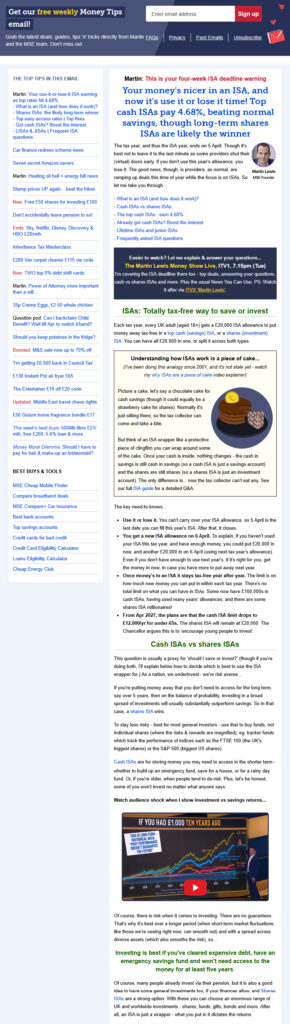
I’ve had to stop cut the email short, this isn’t even half way through!
The MoneySavingExpert email breaks just about every piece of email marketing best practice.
It’s too long.
It’s cluttered.
There are very few images.
There are no obvious calls to action.
It’s difficult to scan.
Yet people read it.
Why?
Because the content is consistently strong.
Who doesn’t want to save money?
I have no information on how these emails perform, but they haven’t fundamentally changed in twenty years, so they’re obviously doing something right.
Now, it’s unlikely that your content will be as universally relevant as saving money.
That’s why good design still matters. We should always make it as easy as possible for customers to understand what we’re offering and how they can take action.
But it’s important to remember that content comes first.
The relevance of the content to the user is usually the biggest factor in whether an email succeeds or fails.
Broadly speaking, there are three reactions people can have when they receive an email.

- They find it interesting and engage.
or - They don’t engage this time, but they understand why they received it.
or - They have no interest in it and wonder why they received it.
Whenever I create an email, I try to imagine these three reactions.
Obviously, I’m aiming for number one.
But I fully accept that number two will often be the outcome.
Not every customer is going to be interested in every message at every moment.
That’s normal.
What I’m trying to avoid is number three.
I don’t want customers receiving content that is completely irrelevant to them.
That’s where trust starts to break down.
Over time, too many emails that fall into category three train people to ignore you.
As a small, local business though, you have a huge advantage.
People should already have a pretty good idea what they’re signing up for when they join your mailing list.
They’re interested in your business.
They know what you do.
As long as your emails stay focused on your core products, services and events, most customers will naturally fall into categories one and two.
And that’s exactly where you want them.